
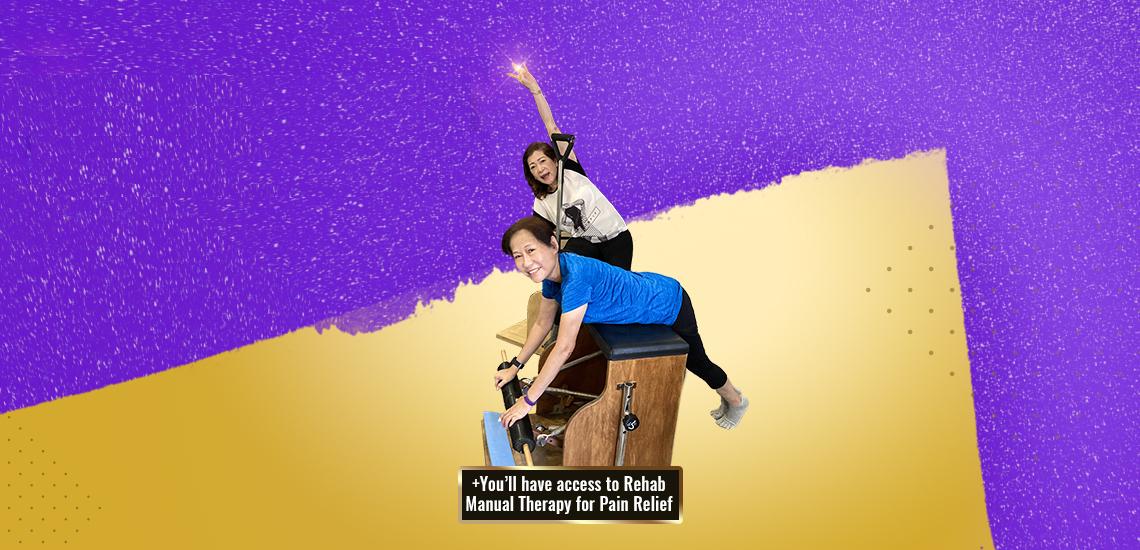
Pilates Gold
Are you ages 65 years and above? Do you want to get active? Or you want to help your parents be more active in their golden years. The good news is fitness has no retirement age. It is never too late to start exercising and reverse the years.
Consider a large-scale study in 2019 which examined the level of activity of over 315,000 participants, aged 50 to 71 years old. The study found participants who were previously inactive, but increased their physical activity in late adulthood (40 to 61 years old) to four to seven hours a week had a 32 to 35% decrease in mortality risk, compared to those who remained inactive. They also caught up with participants who were always active, who had a 29 to 36% reduction in mortality risk.
The fact that older adults, who are new to exercise, could experience similar gains in life expectancy as older adults, who have been active all their lives suggests it is never too late to be active!
WHAT IS YOUR BIOLOGICAL AGE
While you can’t change your chronological age, which is based on the number of birthdays you have had, you can lower your biological age with exercise.
For example, if you are 65 years old, and could climb up a flight of stairs like a 40-year old without feeling breathless, and without knee or ankle pain, your biological age is close to 40 years old. You have the fitness and mobility of a younger person. You can decrease your biological age by staying active. You can be and feel young again.
WHY PILATES
Aches and pain generally increase with age as our joints stiffen and we lose our range of motion. We sometimes need to have a good stretch. The Pilates machines — using the spring system — not only provide the assistance to stretch, but also the resistance to build strength. In fact, the Pilates reformer — a moving bed — has been described as a “magic machine” for resolving pain and muscle imbalance in the body, particularly knee pain.
Apart from stretching and strengthening the body, Pilates also improves your core strength. While walking and resistance training such as carrying light weights are generally recommended for older adults, not much attention has been focused on the midriff. While it is good to have strong arms and legs, we also need our abdominal muscle to be strong to help us get out of bed every morning (trunk flexion), and support our back when we bend over to brush our teeth or pick up an object from the floor.
The deep abdominal muscle, in particular keeps the lumbar spine stable, improves hip health and prevents incontinence. Having trunk stability also translates to better standing balance and reduces the risk of falls. We are only beginning to understand the benefits of core exercise for active ageing.
START TODAY
You are never too old to start Pilates. If you are new, or want to do with a loved one, try our Pilates 1-1 or Duet. See our private classes. Want to be social? Join our small group classes, known as Reformer Gold. See our group classes. Don’t wait, book a class trial today!